


Most people call us with a budget in mind and ask what it will buy. That is the wrong end of the question. The number of deer you should start with is set by your ground first and your checkbook second, and if you get that order backwards you will either overstock a place that cannot carry it or spend a fortune on infrastructure standing mostly empty.
Here is how we walk through it with a new ranch.
Start with what the ground will carry
Carrying capacity is the only honest starting point, and it varies enormously. Native range in this part of Texas — low fence, no supplemental feed, no real management — might carry one deer per twenty to fifty acres depending on rainfall, browse and whether cattle are competing for the same forage.
A high fence changes that math, and not by a little. Once you control the feed and the water you are no longer at the mercy of what your pasture happens to grow in a dry August. Protein in front of them year round, food plots, and reliable water in every pasture means the same dirt will carry substantially more deer than it would hold wild. Ranches managed hard for antler commonly run one deer per six to twelve acres, and run them heavier and healthier than a low-fence herd at half the density.
That is still a range, and it is a range for a reason. Anybody who gives you a single number without seeing your place is guessing. Get a browse survey done before you commit — it costs very little and it is the cheapest mistake to avoid.
Then stock well below it
This is the part that catches people. Carrying capacity is not your shopping list. It is the ceiling you are trying not to hit, and a foundation herd grows on its own — that is the entire point of buying does.
Stock at capacity on day one and you will be over it within a few seasons, with a browse line, thin deer and a doe harvest you did not plan for. As a rough rule we suggest starting at somewhere around a third of what the property can carry, which leaves you room for several years of natural growth before you have to start managing numbers down.
Count the deer you already have. If you closed the fence on a property that already held native deer, those animals count against your capacity, and there may be more of them than you think. A census before you buy anything — camera survey, spotlight count, whatever your biologist recommends — will change your order.
| Acreage | Capacity, fenced and fed | Reasonable foundation order |
|---|---|---|
| Under 200 acres | Very limited | A pen program, not a pasture herd |
| 300 acres | ~25–38 head | 10–12 bred does, 1 buck |
| 500 acres | ~45–60 head | 15–20 bred does, 2 bucks |
| 1,000 acres | ~80–125 head | 25–35 bred does, 2–3 bucks |
| 2,000+ acres | 165+ head | 50+ bred does, 3–4 bucks |
Does are the engine
Every first-time buyer wants to weight the order toward bucks, because bucks are the exciting part and the reason you built the fence. Almost every one of them should buy more does than they planned to.
A stocker buck is one hunt. When he is on the wall, he is gone, and the money went with him. A doe is a producer that pays out every year for the better part of a decade, and half of what she produces is bucks. Twenty does properly managed will put more good bucks on your ranch over ten years than any amount of buck buying, and at a lower cost per animal.
The reasonable exception is timeline. If you want something to hunt this fall or next, you need stocker bucks, because your own fawn crop will not be mature for years. Most of our clients buy a doe-heavy foundation and a small number of stockers to bridge the gap, which is the mix we used in the worked cost example.
If you are stocking a ranch, buy bred does
We sell does two ways, and for somebody putting deer on a ranch the choice is not close. Buy the bred does.
Live bred does, from $3,750. Already carrying when she loads. She fawns the first spring she is on your place, and by the time an open doe would have been bred for the first time you are already a full fawn crop into building your herd.
Yearling open does, from $2,500. About a year old and not carrying. She breeds in the fall as a coming two-year-old and drops her first fawns the spring after that — so she is producing in her second season with you, not her first.
That $1,250 gap looks like a saving right up until you price the year it costs you. Twenty open does keeps $25,000 in your pocket and puts nothing on the ground next spring, and you spend twelve months feeding them to reach the point a bred doe was at the day she stepped off the trailer. The delay compounds too: every season you push the first fawn crop back is a season further out before you shoot a mature buck you raised yourself.
Open yearlings do have a place. They suit a breeder operation that wants to choose exactly which sire covers them, and they make sense if your fence is a year out anyway. But if the fence is up and you want the herd working, bred does are the right animal and the extra money is the cheapest year you will ever buy. Both options are on the does page.
How many breeding bucks you actually need
Fewer than you would guess. In a pasture setting one mature, sound buck can cover a substantial group of does in a single rut, so a herd of twenty does does not need a pen full of bucks — it needs one very good one, and a second so you are not out of business if something happens to the first.
Two considerations that change the math:
- Genetics get expensive at the top. The best sire you can afford to own outright is usually not the best sire you can breed to. Buying semen puts genetics in your herd that would cost six figures to own, and you are not feeding, housing or insuring the animal.
- Inbreeding arrives faster than people expect. Run one buck over a closed herd for several seasons and he will be covering his own daughters. Plan on rotating sires or bringing in outside genetics every few years from the start — it is far cheaper than fixing it later.
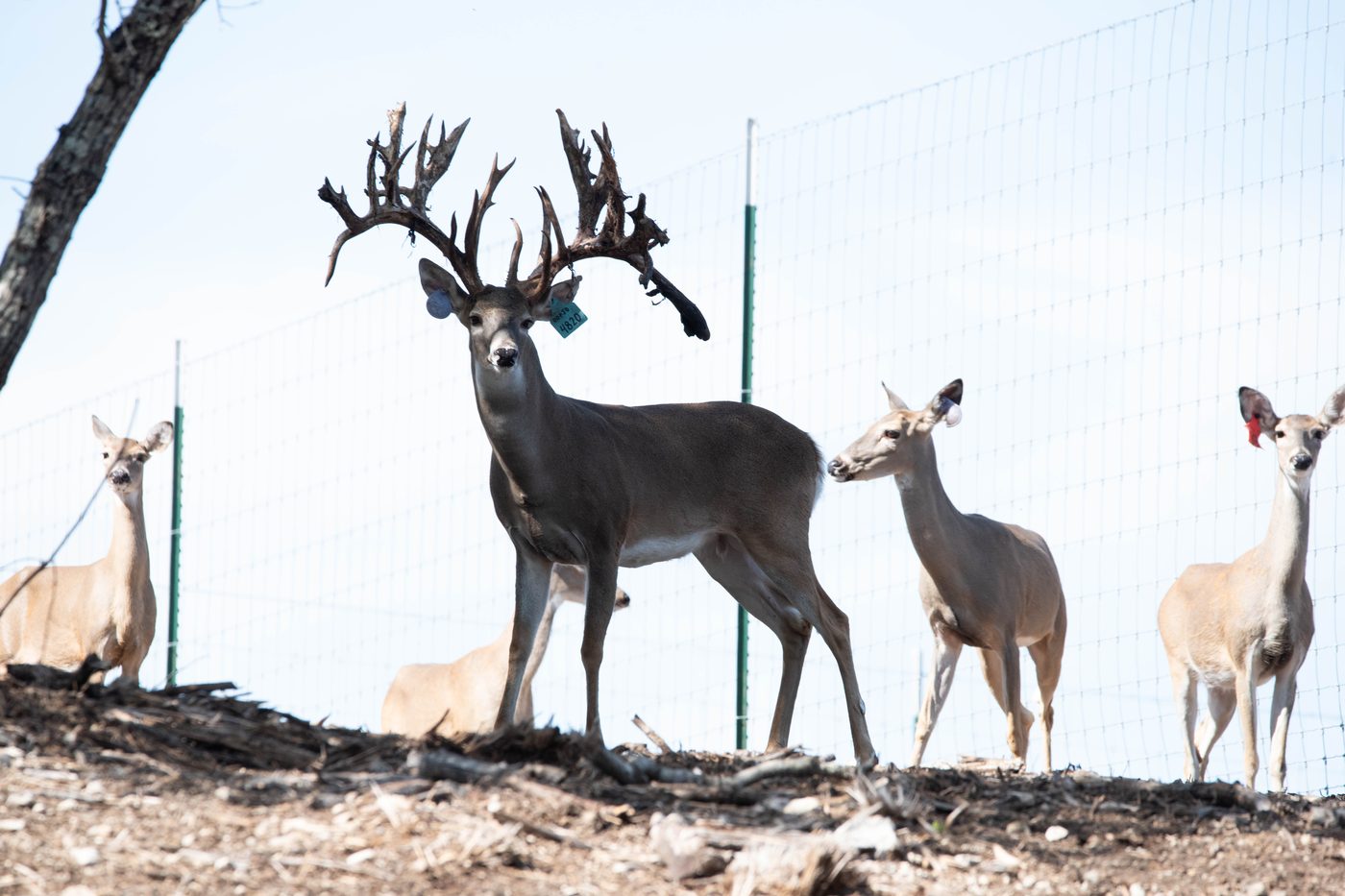
If you want a sire of your own on the place, that is what our breeder bucks are for. If you would rather put better genetics in your does without carrying the animal, we sell straws from the same lines.
What twenty does turns into
Rough arithmetic, deliberately conservative on fawn survival, for twenty live bred does released on managed ground:
| Season | What happens |
|---|---|
| Year 1 | They fawn out their first spring on your place. Figure on roughly a fawn per doe surviving to fall, about half of them bucks. |
| Year 2 | Second fawn crop. The herd is compounding and you have two age classes of home-raised deer on the ground. |
| Year 3 | Herd comfortably past fifty head. Your first doe fawns are breeding themselves and your oldest home-raised bucks are two — the age we sell stockers at. |
| Year 5 | First home-raised bucks reach four and a half. Your first genuinely mature deer, off your own ground. |
The lesson in that table is not the herd count. It is that the does you buy this year decide what walks out of the cedar five seasons from now, and that buying the cheaper animal moves every one of those dates to the right. We will cover that timeline properly in the next post.
Is there a number too small to bother with?
Practically, yes. Below about eight or ten does you are not building a herd so much as buying a few deer, and you are exposed — one bad fawning season or one predator problem sets you back years with no depth to absorb it. You also have very little to select from, and selection is most of how a herd improves.
We will absolutely sell you three does. We will also tell you plainly that a smaller number of better does beats a larger number of average ones, and that if your budget only covers a handful this year, buying the best does you can afford and adding next year is a better plan than filling the pasture with whatever is cheap.
If the fence is not finished
Sizing the order to your acreage assumes the acreage is ready. If it is not, you do not have to sit out a breeding season. Buy the does now and board them with us through the Jumpstart Program at $125 per deer per month. They breed on schedule in our pens, and you take delivery of a herd that has already grown instead of one starting from zero the day your gate closes. This is also the one situation where open yearlings make good sense — if they are going to spend a year in our pens anyway, let them come of age here and breed here.
The short version
Get a real carrying-capacity number for your property, count the deer already inside the fence, then stock at roughly a third of capacity, weighted heavily toward does. Buy bred does, not open yearlings — the extra money buys you a full year of production. One or two good breeding bucks is plenty. Add stockers only for the seasons you want to hunt before your own deer are ready.
Tell us your acreage and what you want the place to be doing in five years and we will tell you what we would put on it — including telling you it is fewer deer than you were planning to buy, if that is the answer. Call 714-388-7020.
 Crown Point Whitetails
Leave a comment