
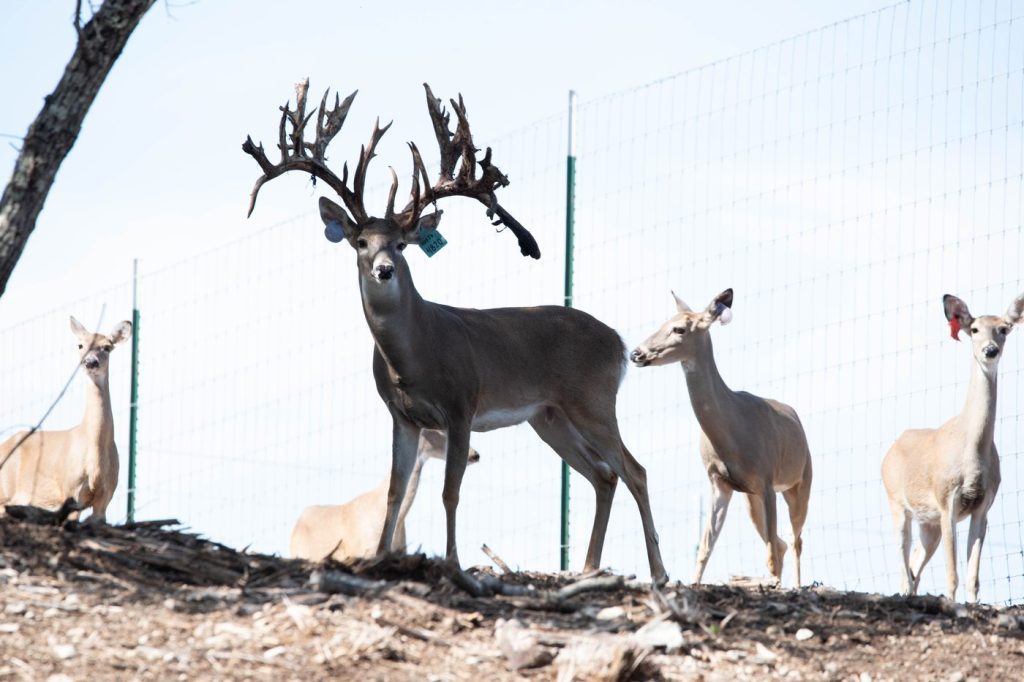


There are two ways to get your does bred, and the whitetail industry talks about them as if one is obviously more sophisticated than the other. That framing costs people money. Both are legitimate tools, they solve different problems, and the right answer for a small ranch herd is usually not the one that sounds most advanced.
Natural cover: a buck and a pasture
You put a mature buck out with your does and let the rut do the work. No handling, no restraint, no drugs, no technician’s schedule, nothing to synchronise.
What it gets you. Reliability, mostly. A sound buck running with a group of does through a full rut will settle a very high proportion of them without you doing anything, and he will find the ones cycling late without needing a calendar. It is also the only option that works if you do not have a handling facility, which most new ranches do not.
What it costs you. Three things, and only one of them is money.
- A ceiling on genetics. Your fawn crop can only be as good as the buck you can afford to own outright, and that is a considerably lower bar than the buck you could afford to breed to.
- Single-point failure. One buck covering your herd means one injury, one illness or one sub-fertile animal costs you an entire fawn crop, and you will not find out until the following spring.
- Inbreeding on a timer. Run the same buck over a closed herd for a few seasons and he starts covering his own daughters. This arrives faster than people plan for.
AI: breeding above your budget
The case for artificial insemination is simple and it is strong: it decouples the genetics you use from the animal you can afford to own.
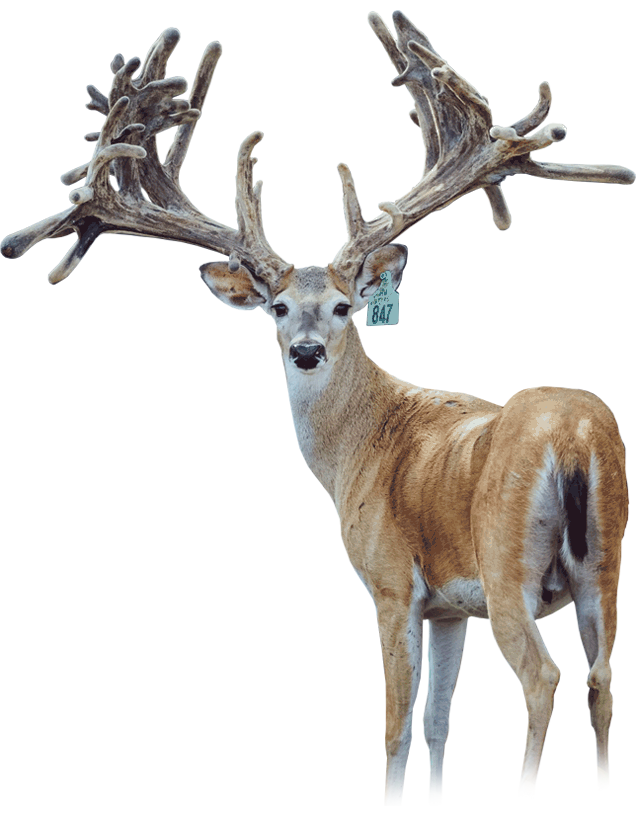
A sire whose straws you can buy is a sire you would never write a cheque for outright. You are not feeding him, housing him, insuring him or worrying about him getting hurt in a pen. You can also use several different sires across one breeding season, which spreads your genetic risk instead of concentrating it in one animal, and gives you something to compare when the fawns hit the ground.
For a program trying to move its herd forward quickly rather than just maintain it, that is the whole ballgame. Our AI sires and the straws on the semen page exist for exactly this.
What AI actually requires
This is the part that gets glossed over when somebody sells you straws, and it is where most first attempts go wrong. AI is not a purchase, it is a procedure, and the procedure has prerequisites.
- You have to catch the doe. On a schedule, calmly. If you cannot reliably put hands on a specific animal on a specific day, you cannot do AI. Pasture does that have never been handled are not candidates.
- A real handling setup. Pens, an alley, restraint, shade. Improvising this is how does get hurt and how the whole exercise fails.
- Synchronisation, on time. The does have to be brought into cycle together and inseminated in a narrow window. Miss the window and the straws are wasted.
- A technician, on their calendar not yours. Good AI techs are booked in season. The timing is driven by the protocol, so you work around it.
- Tolerance for a lower settle rate. Expect a meaningfully lower conception rate per attempt than a buck running with does through a full rut. That is normal and it is not a sign anything went wrong — but it means you plan for it rather than discover it, and the cost per pregnancy is higher than the cost per straw suggests.
Add the straws, the technician, the drugs, the handling labour and the does that do not settle, and AI is materially more expensive per fawn on the ground than natural cover. It is worth it when the genetics justify it. It is not worth it to breed average does to a slightly better buck.
Side by side
| Natural cover | AI | |
|---|---|---|
| Genetics available | Capped at what you can own | Effectively uncapped |
| Settle rate | High | Lower per attempt |
| Cost per pregnancy | Low once you own the buck | Higher |
| Infrastructure | A fence | Pens, restraint, a technician |
| Sires per season | One, usually | As many as you like |
| Ongoing burden | Feed and house a buck year round | None between seasons |
| Inbreeding risk | Builds every year | Easily managed |
What we would actually do on a small ranch
Both, split by animal. This is the recommendation and it is not a hedge.
Run natural cover on the pasture herd. The bulk of your does, out on the ground, covered by a good breeder buck. High settle rate, no handling, no fuss. This is your production.
Use AI on a small selected group. Pick your best five or ten does — the ones with the strongest maternal lines — keep them where you can handle them, and breed them to a sire you could never afford to buy. That is your improvement program, and the buck fawns out of it are your future sires.
You get the reliability of natural cover across the herd and the genetic jump of AI where it compounds hardest. And you solve the inbreeding problem structurally, because outside genetics arrive every year without buying another animal.
When to skip AI entirely
Plainly, because there is no reason for us to talk you into straws you should not buy:
- You have no handling facility and no plans to build one.
- Your does are pasture animals that cannot be caught on a schedule.
- You are in your first year or two and still sorting out fence, water and feed. Fix those first — nutrition will move your antler numbers more than genetics will at this stage.
- You are running a hunting ranch and are content with the deer a good breeder buck produces. That is a perfectly respectable place to stop.
The short version
Natural cover is cheaper, more reliable and capped by what you can afford to own. AI is more expensive and less certain per attempt, and it removes the cap entirely. Most small ranch herds should run natural cover on the pasture and AI a handful of their best does, then use what comes out of that as their next sires.
Whichever route you take, read the pedigree before you commit — here is how. If you want to talk through which of your does are worth breeding up and which sire fits them, call 714-388-7020.
 Crown Point Whitetails
Leave a comment